The Founding Team: Regional Expertise and Global Reach

The Baghdad Center was founded by Virginia Tech researchers whose combined backgrounds reflect the diversity of the region and the strength of Washington's intellectual and policy community.
Board of Directors
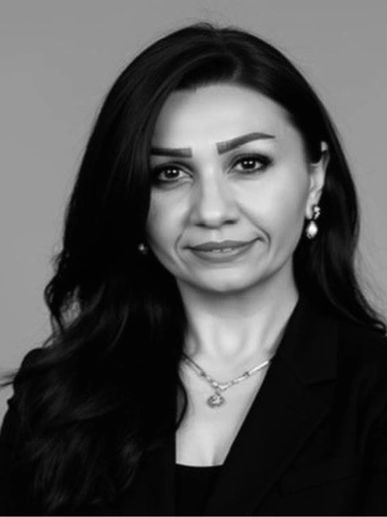
Hiba Abdulwahhab
Founder and Executive Director
Hiba Abdulwahhab is an Iraqi researcher, political analyst, and private advisor on Iraqi politics. A central focus of her work is Iraqi national identity: how it has evolved since 2003, how political fragmentation and competing loyalties have challenged it, and what it means for the future of the Iraqi state. Her research also examines governance, armed factions, Iranian influence, and broader questions of Middle East politics and security. Through her articles, policy analysis, and media commentary, she connects developments inside Iraq to the wider regional and international landscape.
Hiba has collaborated with the Gulf International Forum, the Wilson Center’s Middle East Program, and the Washington Center for Human Rights. Before pursuing research in the United States, she practiced law in Iraq. She holds a master’s degree in Public and International Affairs from Virginia Tech, a master’s degree in Arabic Language and Linguistics from Pennsylvania Western University, and a bachelor’s degree in law from the University of Baghdad.
As Founder and Executive Director of the Baghdad Center for Policy and Strategic Studies, Hiba leads its work to bring research grounded in the region into policy discussions in Washington and beyond.

Dr. Farhad Mamshi
Co-founder
Dr. Farhad Mamshai, is a Research Scholar at Virginia Tech’s School of Public and International Affairs. His research focuses on environmental security, water politics, climate-related conflict, ethnic and communal conflict, and governance in Iraq and the broader Middle East. He earned his Ph.D. in Planning, Governance, and Globalization from Virginia Tech and has extensive experience in academic research, university teaching, and field-based qualitative and quantitative research. He serves as an editor for *Community Change* at Virginia Tech and as a member of the International Editorial Advisory Board of *Asian Affairs*. He previously served as Editor-in-Chief of the Kurdistan Conflict and Crisis Research Center (KCCRC).
.jpeg/:/cr=t:17.85%25,l:0%25,w:100%25,h:46%25/rs=w:388,h:388,cg:true)
Dr. Julie Schupp
Board Member
Dr. Julie Schupp is a researcher and educator specializing in peacebuilding, peace education, and international affairs. She holds a Ph.D. in Planning, Governance, and Globalization from Virginia Tech, where her research examined the long-term retention of peace education concepts across conflict-affected and U.S. contexts. Her research experience includes fieldwork with displaced communities in the Kurdistan Region of Iraq, as well as work in the United States and internationally. She has lived and worked abroad and brings extensive international experience to her research and policy interests. Her work focuses on the intersection of education, conflict, governance, and sustainable peace.
Dr. Gopi Bhamidipati
Board Member
Dr. Gopi Krishna Bhamidipati is an international relations scholar, policy researcher, and geopolitical analyst specializing in the Middle East, Gulf security, India–Middle East relations, and strategic affairs. He holds a Ph.D. in Planning, Governance and Globalization from Virginia Tech. His doctoral research examined India’s strategic autonomy and foreign policy toward the Gulf Cooperation Council (GCC), Israel, and Iran, drawing on both contemporary international relations theory and Kautilyan strategic thought.
His research and policy analysis have been published by leading academic and policy institutions, including the New Lines Institute, the Arab Gulf States Institute in Washington (AGSIW), and the Middle East Institute at the National University of Singapore (MEI NUS). His work examines the changing geopolitical order in the Middle East and Indo-Pacific, with particular attention to Gulf security, India’s expanding regional role, Iran–Israel relations, maritime and energy security, U.S. strategy, and the intersection of South Asian and Middle Eastern geopolitics. He has also been quoted and featured in major international media and policy discussions on regional security and conflict.
Dr. Bhamidipati has taught foreign policy and diplomacy at Virginia Tech and has contributed extensively to academic and policy debates through scholarly publications, policy reports, and strategic analysis. His forthcoming work includes a book chapter with Palgrave Macmillan on how the Iran–Israel rivalry is shaping GCC–India relations. With extensive experience in think tanks and journalism, he brings expertise in international relations, Middle Eastern geopolitics, Gulf and South Asian strategic affairs, and international security to the Center's research and policy activities.
Dr. Yagiz Sullu
Board Member
Yagiz Sullu, PhD, is a political risk and geopolitical analyst specializing in governance, international political economy, energy security, and strategic risk in developing and resource-dependent economies. He is among the first scholars to systematically examine how declining oil production influences authoritarian resilience, advancing new research on the political and economic consequences of resource depletion.
He holds a Ph.D. in Planning, Governance, and Globalization from Virginia Tech, where his doctoral research developed an original framework linking natural resource dynamics, institutional development, and political stability. His work combines rigorous qualitative and quantitative methodologies to produce actionable intelligence for policymakers, businesses, and international organizations.
Prior to founding Sullu Strategic Advisory LLC, Dr. Sullu worked at the Washington Institute for Business, Government, and Society, where he collaborated with former U.S. Assistant Secretary of Commerce for Trade Development James P. Moore Jr. on strategic research, executive briefings, and international initiatives. His work supported engagements with senior government officials, business leaders, and global stakeholders on issues including geopolitical risk, energy security, economic development, and Ukraine's reconstruction.
Throughout his career, Dr. Sullu has produced executive briefing materials, policy analyses, and strategic research covering political risk, governance, energy markets, international trade, and global affairs. His analysis has informed discussions involving organizations such as the U.S. Department of Commerce, USAID, diplomatic representatives, private-sector leaders, and nonprofit institutions.